A Kavala tuk tuk tour is a city tour of Kavala in northern Greece in an eco friendly tuk tuk, from a 25-minute evening ride to a 2-hour grand tour. Planning more of Greece? Browse our Greece tours.
This page compares each Kavala tuk tuk tour by length and label, then covers what a tuk tuk is, where Kavala is, its history, the old town of Panagia, the fortress, the Kamares aqueduct, the Imaret, the harbour, Philippi, the weather, the other Kavala tours and how to book on GetYourGuide.
Table of contents
What Is A Kavala Tuk Tuk Tour?
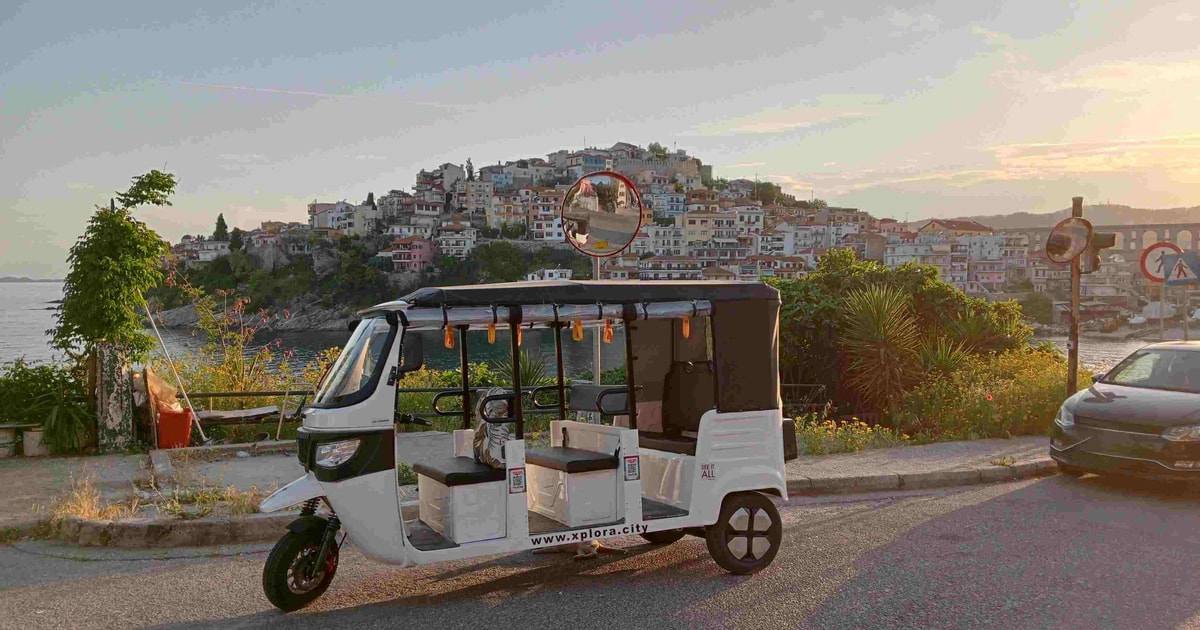
A Kavala tuk tuk tour is a city tour of Kavala in northern Greece. It runs in an eco friendly tuk tuk. This page compares 3 listings on GetYourGuide, so you can match one listing to the time you have free.
The City Grand Tour is the longest Kavala tuk tuk tour listing and lasts 2 hours. The second listing is the City Tour that lasts 1 hour. Its page text says you explore the city in an ecological tuk-tuk. It adds a multilingual audio guide.
The Evening Snapshots Tour lasts 25 minutes, and its page text says it shows the city at sunset. All 3 carry the private option available label. Pick the Kavala tuk tuk tour length first, then pick the time of day that suits your plans.
How Long Is A Kavala Tuk Tuk Tour?
The 3 tours run from 25 minutes to 2 hours. A Kavala tuk tuk tour comes in three clear lengths. Each listing gives one exact figure on its own page. You can compare them side by side before you choose.
The Evening Snapshots Tour is the shortest of the 3 at 25 minutes. The City Tour of 1 hour is the middle length. It is shorter than the 2 hour listing, and the Kavala tuk tuk tour of 25 minutes is shorter still.
The City Grand Tour is the 2-hour listing. The length on each page is the time you spend on the tuk tuk. Plan the rest of your day around that figure, and leave room before and after the tour.
What Is The Vehicle On A Kavala Tuk Tuk Tour?
A tuk tuk is an auto rickshaw, a motorised version of the pulled rickshaw or cycle rickshaw. An engine powers its three wheels. The fuels named are petrol, compressed natural gas, liquefied petroleum gas and electricity. It is a common form of transport around the world, both as a vehicle for hire and for private use.
The common passenger type has a sheet-metal body on three wheels, with a canvas roof and drop-down side curtains. The driver sits in a small cabin at the front and works handlebar controls. The back has space for up to three passengers.
The name tuk tuk is onomatopoeic and mimics the sound of a small engine. In Thailand the vehicle is called tuk tuk, and it is a widely used form of urban transport in Bangkok. In Egypt it is the “tuktuk”.
In Cambodia the three-wheeled passenger vehicle is known as rœmâk. Tuk-tuks serve visitors in Lisbon and the Algarve as transport. Auto rickshaws also carry people in cities and towns over short distances. A Kavala tuk tuk tour is built around this kind of three-wheeled vehicle.
Where Does A Kavala Tuk Tuk Tour Run?
Kavala is a city in northern Greece and the capital of the Kavala regional unit. The unit lies in the region of Eastern Macedonia and Thrace. The city sits on the Bay of Kavala, across from the island of Thasos, and is built amphitheatrically. The Kavala tuk tuk tour listings all run in this city.
The Egnatia Odos motorway lies north of the city. You can enter Kavala from two junctions, Kavala West and Kavala East. Kavala International Airport “Alexander the Great” is connected with Athens by scheduled flights. KTEL buses link the city with Thessaloniki and Athens.
Kavala is not connected to the rail network. Ferry lines connect the city with all the islands of the North Aegean. A ferry route also links Scala Prinos on Thasos with Kavala. The city also has a local shuttle bus.
The city expanded towards the sea on land reclaimed west of the port. Thasos, the island across the bay, is mountainous but not particularly rough. Pine forest covers much of its eastern slopes.
What Is The History Of Kavala?
In antiquity the city was called Neapolis. It was one of the Thassian colonies along the coast, all founded to use gold and silver mines. Under Roman rule it was a major commercial station on the Via Egnatia and the port of Philippi. The road helped trade to flourish.
A large Ionic temple made from Thassian marble replaced an earlier Archaic temple. Parts of it can now be seen in the town’s archaeological museum. The Apostle Paul landed at Neapolis on his first voyage to Europe, according to Wikipedia.
In the early Middle Ages the city was renamed Christoupolis, “city of Christ”. A Byzantine emperor fortified it against barbarian raids. Excavations found an early Byzantine basilica under an Ottoman mosque in the Old Town. The Ottomans extended the fortress on the hill of Panagia.
Kavala was the first European port of call for merchants and travellers from the Middle East. Refugees from Anatolia later gave the city a new period of prosperity. The city grew in tobacco processing and trading. After the Second World War it faced economic decline and emigration.
What Is Panagia, The Old Town Of Kavala?
Panagia is the old town of Kavala, on the peninsula. Wikivoyage says remains of the Byzantine fortifications can be seen at points around it, as well as the castle.
The church of Agios Nikolas on Kontouriotou Street has a mosaic of the Apostle Paul landing in Kavala. Around it are cafés, ouzo bars, restaurants and small shops. The Halil Bey Complex has a mosque, an older minaret and a medrese. A modern glass floor shows part of an old church nave with its Byzantine floor.
A free bus that looks like a tourist train, “Trainaki”, runs from the main square to the old town.
What Is The Kavala Fortress?
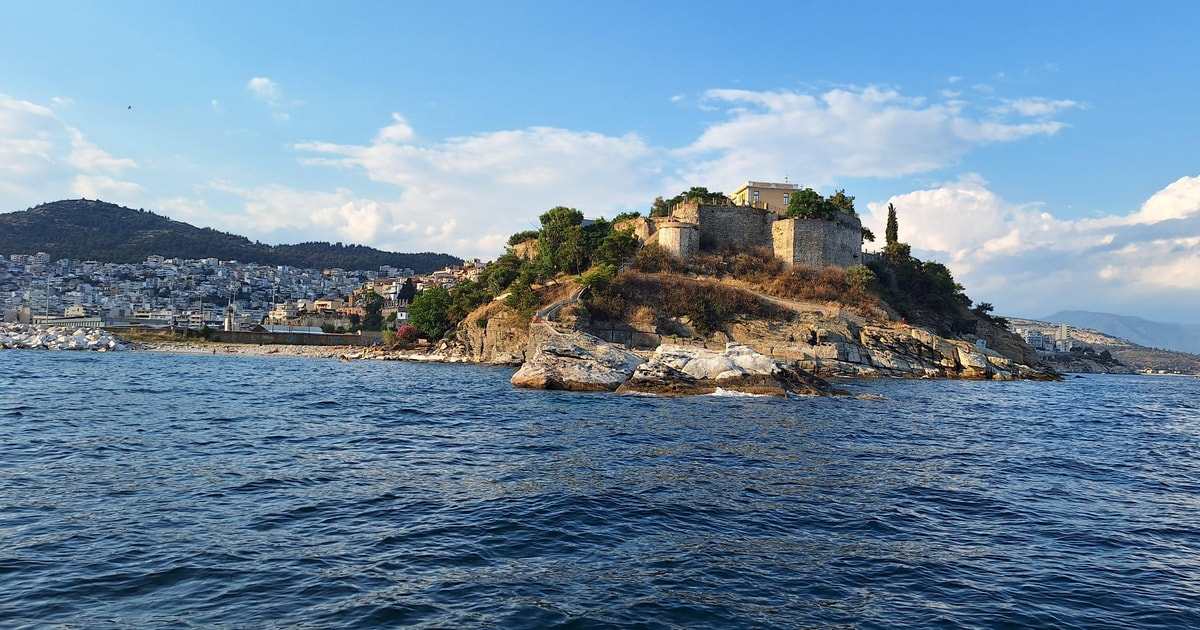
The Kavala Fortress is a Byzantine citadel at the highest point of Panagia. The Ottomans later extended it. Wikivoyage lists a circular path around the city wall. A picture on the Wikipedia page shows the old town as seen from the castle.
The castle stands on a hill above the town and gives a sea view and a view over the city. A simple cafeteria is there too. Wikipedia calls the fortress and the aqueduct recognizable symbols of the city.
Wikivoyage says the walk from the harbour to the castle takes 15 to 20 minutes. Its list of sights in inner Kavala names the Arsenal beside the castle. Wear flat shoes if you plan to walk up the hill.
What Is The Kamares Aqueduct In Kavala?
Kamares is an aqueduct that divides the old and new parts of Kavala, according to Wikipedia. Wikivoyage calls it well preserved and one of the landmarks of the city. It adds that the aqueduct was cleaned and repaired in recent years.
The aqueduct is of Roman origin. The present structure goes back to a repair of the Byzantine fortifications under Suleiman the Magnificent. It reaches up to 25 m high and 280 m long and has 60 arches. Old houses were built into it.
Wikivoyage says you can climb on it for a short way. Another source credits Ibrahim Pasha, the Grand Vizier of Suleiman, with reconstructing the late Roman aqueduct. The sources name a Roman origin and an Ottoman rebuilding, so no single builder is named here.
What Are The Imaret And The Mohamed Ali House?
The Imaret is a classic example of Islamic architecture that has survived almost intact. It operated as a Muslim seminary and later became a refuge for Greeks driven out of Asia Minor. It was restored and converted into a hotel.
Wikivoyage says it is difficult to get in if you are not a hotel guest. Mohamed Ali moved to Kavala when young and emerged there as an Ottoman commander. He founded the dynasty that ruled Egypt, and his father was a tobacco and shipping merchant.
The Mohamed Ali House was the largest house in the town in its time. It is an example of eighteenth-century Ottoman architecture and contains a museum. Its large garden operates as a bar-restaurant. The house stands at the top of the old town as a museum and coffee house.
Next to the house stands a bronze equestrian statue of him. The Municipal Tobacco Warehouse combines Ottoman architecture with neoclassical elements. Other buildings for storing and processing tobacco from that era are preserved in the city. They still form part of the cityscape.
What Is The Harbour And Seafront Of Kavala Like?
The harbour is the central point for recreational, commercial, business and tourist activity. It serves the fishing fleet, tourism and ferry boats to and from Thasos, Limnos and Mytilene. The marina has water sports. A Kavala tuk tuk tour starts in a city whose seafront is also a working port.
Kavala is an important economic centre of Northern Greece and was formerly a thriving centre of the tobacco trade. Fishing was the traditional main occupation, and fish and seafood are the main elements of the cuisine. The city’s nickname is “the cyan city”.
The districts named include Agia Varvara, Agios Athanasios, Agios Ioannis, Dexameni, Kalamitsa, Kentro, Neapolis, Panagia and Perigiali. The Kavala Water Trail is a hiking trail linking Palaia Kavala with the Agios Konstantinos neighbourhood. Cultural events take place mostly in summer.
What Is Philippi, Near Kavala?
Philippi was a major mainland Greek city north-west of the island of Thasos. Its original name was Crenides, which means “Fountains”, and Philip II of Macedon renamed it. The ruins lie within the modern municipality of Kavala. The Archaeological Site of Philippi is a UNESCO World Heritage Site.
Wikipedia puts the settlement about 13 km north-west of Kavala. The site controlled the route between Amphipolis and Neapolis, which the Romans later rebuilt as the Via Egnatia. The settlement lay at the foot of Mount Orbelos, now called Mount Lekani.
The remains include walls, the Greek theatre, a forum laid out in two terraces and Basilicas. The Roman city was called a “miniature Rome”, and the theatre was enlarged and expanded to hold Roman games.
The New Testament records a visit by the Apostle Paul to the city. The first church described there is called the Basilica of Paul. Nine of the other listings on this page name Philippi. No Kavala tuk tuk tour title on this page names Philippi.
What Is The Weather Like In Kavala?
Kavala has hot, dry summers from mid-June to mid-September and wet, cool winters from November to April, says Wikivoyage. It is not as hot as southern Greece in summer, but it is colder in winter. The swimming season ends in mid-October.
The climate is hot-summer Mediterranean. Snow is sporadic but falls more or less every year, and the humidity is always moderate to high. Kavala also hosts a wide array of cultural events, which mostly take place during the summer months.
Bring a hat and water in summer and a rain layer in the cool months for any outing, including a Kavala tuk tuk tour. The neighbouring island of Thasos has mild winters and hot summers, so the same clothing advice holds across the bay.
Which Labels Matter On A Kavala Tuk Tuk Tour?
The page also lists 25 other Kavala trips, and none of them is a Kavala tuk tuk tour. They cover food, wine, Philippi and boat outings. Compare each one with the three tuk tuk listings before you choose a day.
Three listings are food, cooking or street-food tours, and five are wine tours. Nine trips go to Philippi or Lydia, and five are boat, yacht, cruise or sailing trips. Four of the trips start from Thessaloniki.
The three Kavala tuk tuk tour listings all show a private option and free cancellation. Two of them, 682833 and 915517, add an optional audio guide. Two others, 915517 and 998690, carry the small group label, so listing 915517 holds both labels.
Booking notice differs between the Kavala tuk tuk tour listings. Tours 682833 and 915517 ask for 20 minutes, while tour 998690 asks for 10 hours. The 20 minutes of notice make the two daytime tours easy to add to a plan.
How Do You Book A Kavala Tuk Tuk Tour On GetYourGuide?
Start by choosing one of the three Kavala tuk tuk tour listings on this page. The choices are the grand tour, the city tour and the evening snapshots. Open that tour’s page on GetYourGuide to see all its details.
Read the length, the labels and the notice the page asks for. Then pick the date, the time and the number of travellers. Add the private option if you want the tuk tuk for your own party.
Pay on the booking page and save the booking to your phone for the start of the tour. You will need it at the start of the tour. Charge the phone beforehand so the booking opens when you need it.
Kavala Tuk Tuk Tour: Questions And Answers
How long is a Kavala tuk tuk tour?
A Kavala tuk tuk tour comes in three lengths: 25 minutes, 1 hour and 2 hours. Pick the length first, because it sets how much time the trip takes from your day. Every listing page shows the length of its tour.
Can you book a private Kavala tuk tuk tour?
Yes, all three Kavala tuk tuk tour listings carry the private option available label on their pages. Choose that option while you book if you want the tuk tuk for your own party. Pick it before you pay.
Is there an audio guide on a Kavala tuk tuk tour?
An optional audio guide appears on two of the three Kavala tuk tuk tour listings. The label is not on the third tour, so check each page before you choose. The audio guide is an extra you add when you book.
How far ahead do you book a Kavala tuk tuk tour?
The two daytime tours ask for 20 minutes of notice before the start. The evening tour asks for 10 hours of notice. Book the evening tour well ahead, and check the notice line on each page.