A Chania 9D cinema show is a short film with moving seats and special effects at Minoan’s World in Chania on the island of Crete, and the same ticket covers a 3D museum. Planning more days in Greece? Our Greece tours page has them.
This page shows the Chania 9D cinema ticket by length and labels. It then covers Minoan’s World, the Minoans, Knossos, the old town of Chania, the myths of Crete, the weather, the other Chania tours and how to book.
Table of contents
What Is A Chania 9D Cinema Show?
A Chania 9D cinema show is a short film show at Minoan’s World. The venue stands in the city of Chania on the island of Crete. The official pages say the chairs move and special effects play with the film. This page lists 1 ticket for it.
The official FAQ calls Minoan’s World a 3D museum and a 9D cinema themed around the Minoans. The film show is one of two parts of the venue. The 3D museum is the other part. Both parts follow the same theme, so the museum and the show share one subject.
The ticket title says it is a 9D experience at Minoan’s World. The page text names the 3D museum and the 9D cinema. So the ticket for a Chania 9D cinema show covers both parts of the venue, not only the cinema.
Open the ticket page for the details of the Chania 9D cinema show you plan to book. The page is the place to check what the ticket covers for your visit. Match those details against your own plan before you decide, and ask the seller if a point is unclear.
Think about what you want from the visit: the film show, the museum visit or both. This page lists one ticket, so there are no ticket types to compare. One yes or no settles the choice, and the ticket page then fills in the details.
What Does The Chania 9D Cinema Ticket Include?
The Chania 9D cinema ticket covers the 3D museum and the 9D cinema for 45 minutes. That is the length the ticket page shows. The same page adds three labels and a notice time for booking. Each of these details is stated on the ticket page itself.
The page text says the visit has two activities, one for each part. In the 3D museum, it says you take part in photoshoots. In the 9D cinema, it says you get a time-travel experience. So the photos belong to the museum part, and the time travel belongs to the cinema part of the visit.
The official FAQ gives the whole experience as 45 minutes. The FAQ words the split as 15 minutes for the photoshoot in the 3D museum. The screening in the 9D cinema gets the other 30 minutes. So the film show takes the longer part of a Chania 9D cinema visit.
The ticket page carries three labels. The first says an audio guide is optional. The second says the ticket is wheelchair accessible. The third says the ticket has free cancellation. These are the seller’s labels, so check each one on the ticket page before you plan around it.
The ticket page says to book at least 30 minutes in advance. That notice time matters for a same-day visit. Check it before you plan a Chania 9D cinema show for the day you arrive. Leave that gap in your plan so the visit does not start before the notice time ends.
What Is Minoan’s World, Home Of The Chania 9D Cinema?
Minoan’s World is a venue in Chania, Crete, with a 3D museum and a 9D cinema. The official FAQ says both parts are themed around the Minoans. Use the full name, Minoan’s World, when you look for the venue on a map.
Greeka says the visit starts with the 3D museum tour and the 9D cinema comes afterwards. The same page says the cinema immerses the viewer in the world on screen. Plan your day in that order, with the Chania 9D cinema as the second part.
The official 9D cinema page lists four films in a show of about thirty minutes. It calls the show a brief look into the Minoan civilization and Crete. The films are Beauty of Crete, Intro – Welcome, Minoan’s World and Canyon Coaster. They run five, five, fifteen and five minutes in that order.
The Chania 9D cinema runs 5.1 surround audio, according to the official FAQ. The FAQ adds that each guest is offered a pair of bone conduction headsets with 14 languages to choose from. Each guest gets their own pair, so the language is a personal choice. Think about which language you want to hear.
For strollers and wheelchairs, the official FAQ answers yes at both the 3D museum and the 9D cinema. The accessibility page names groups for whom the operator does “NOT recommend the 9D cinema experience”. Read the operator’s own rules on that page before you go, and check them for every person in your party.
How Does The Chania 9D Cinema Work?
According to the official FAQ, the cinema is a combination of a FullHD 3D projector, surround audio and special effects. No official page says what the nine dimensions are. Judge the show by the effects it names, not by the number in its name.
Both official pages name wind, rain, snow, bubbles, lightning and an earthquake effect for the Chania 9D cinema. Between them they also name fog and smoke. The FAQ adds that the chairs move and the show can get loud.
Four steps appear on the official 9D cinema page. Step one is to put on your 3D glasses, and step two is to buckle your seat belt. Step three is to grip the handles of the seats, and step four is to travel back in time.
A 4D film pairs motion pictures with synchronised physical effects in the cinema. Seats in 4D venues move, Wikipedia says. A motion simulator is a mechanism that creates the feeling of real motion. Its movement is synchronised with a picture of the scene outside. These are general facts, not a description of the Chania 9D cinema.
A 3D film is a motion picture made to give the impression of depth. In one system, the viewer wears glasses with two filters set differently. Each filter passes only light polarized the same way, so each eye sees a different image. Treat this as background about 3D films in general.
What Is The 3D Museum Before The Chania 9D Cinema Show?
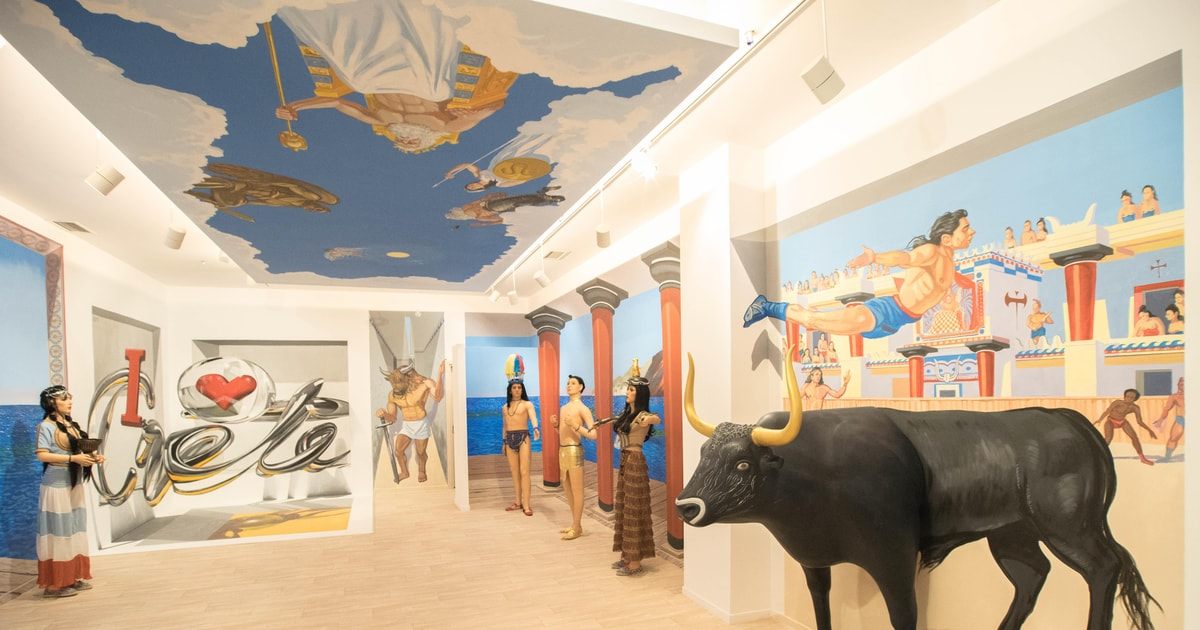
The 3D museum at Minoan’s World is a museum you can interact with. The official FAQ says you take pictures with its paintings and statues. The same FAQ answers no when asked whether Minoan’s World is an archaeological museum. The official homepage calls this part a guided 3D photo tour with storytelling.
The official 3D museum page lists the exhibits you interact with: 3D wall paintings, life-like statues, legends and important figures. Greeka adds that the statues are made of silicon. The page names photo moments too: holding the Minotaur, bull leaping and a place among the ancient Greek gods.
Forced perspective gives each picture its 3D look, the official FAQ says. The paintings and statues come to life through your phone’s camera. The same FAQ says the exhibitions are handcrafted replicas and original art based on frescoes found in Crete and Santorini.
Bring a charged phone for the photo moments the pages describe. Picture-taking runs on your phone, so check the battery before you head to the Chania 9D cinema show. Plan each pose with your group: decide who stands where and who holds the phone. Take a trial picture first, then adjust your pose.
Who Were The Minoans?
The Minoans were a Bronze Age civilization centred on the island of Crete. The Chania 9D cinema stands on that same island. The civilization is known for its monumental architecture and Minoan art. Little is known about how Minoan society was organised, and it is unclear whether a single Minoan state ever existed.
In the myth, King Minos ruled Knossos long ago, and Wikipedia says the word Minoan comes from his name. Minoan is a modern word, so the Minoans did not use it. The name they used for themselves is unknown. Arthur Evans popularized the term.
Besides Crete, the Minoans had more settlements around the Aegean Sea. The majority of Minoan sites lie in central and eastern Crete. Palaces stood at Knossos, Phaistos, Zakros and Malia. Hagia Triada is a site linked to the Minoan palaces. The Minoans also left behind ruins of cities, tombs and mountaintop sanctuaries.
Crete lies in the south of the Aegean, along sea routes that link Europe, Africa and the Middle East. The Minoans exported farm products and crafts in exchange for raw metals that were hard to get on Crete. Minoan-made goods suggest trade with mainland Greece, Cyprus, Syria, Anatolia, Egypt, Mesopotamia and, farther west, the Iberian Peninsula.
On their farms the Minoans raised cattle, sheep, pigs and goats, and they grew wheat, barley, vetch and chickpeas. The official history page adds domesticated bees and cultivated grapes, figs and olives. Read these farm foods and place names once before the Chania 9D cinema trip.
What Are The Minoan Palaces Of Crete?
The pages name Knossos, Phaistos, Malia and Zakros as Minoan palace sites on Crete. Wikipedia says Minoan palaces consist of wings arranged around an open rectangular court. Despite the name, it is generally agreed that these buildings did not mainly serve as royal residences. Remember these names for your Chania 9D cinema trip.
Knossos is an archaeological site and urban centre in Crete, at the southern edge of Heraklion. The Palace of Minos dominates the site, and scholars read it as an administrative, economic, religious and ceremonial centre. The Throne Room contains a stone seat against the wall, benches and painted griffins. The room’s use is still debated.
Phaistos lies in south central Crete, and its remains include a Minoan palace and the town around it. The palace seemed to serve religious and political purposes, with sections for storage, housing and a theatre. Malia lies on the northern coast of Crete. Its palace has three courts: Central, North and Northwest.
Zakros is a Minoan archaeological site on the eastern coast of Crete, in Lasithi. Its protected harbour and strategic location made it a commercial hub for trade to the east. The official history page calls Hagia Triada a site associated with Minoan palaces.
Kydonia, at modern Chania, is a Minoan palatial site. Pin each name on a road map of Crete for your Chania 9D cinema trip. Use these spellings in your searches so that you find the matching pages for each site.
What Did Minoan Art And Daily Life Look Like?
Minoan art is known from frescoes, pottery and figurines. Wood and textiles have decayed, so pottery and palace architecture are among the surviving examples of Minoan art. Read about this art first, then plan your Chania 9D cinema trip around the details that you want to check.
Frescoes on Crete are normally found as partial fragments that need reconstruction. In Minoan frescoes the men are painted with reddish-brown skin and the women with white skin. Pottery shows designs from nature, such as fish, squid, birds and lilies. The Marine Style covers a whole pot with octopus, fish and dolphins against rocks, seaweed and sponges.
The double axe, or labrys, was a sacred symbol of the Minoan religion. Bull-leaping appears in painting and sculpture and is thought to have had a religious meaning. Its technique and the reasons for it remain obscure. Two Knossos figurines are called snake goddess figures, and scholars debate whether they show a goddess or priestesses.
In Minoan art, men wear loincloths, robes or kilts. Women wear long dresses with short sleeves and layered, flounced skirts. Sheep wool was the main fibre in Minoan textiles. Jot these details down before your Chania 9D cinema trip.
How Did Minoan Writing And The Civilization End?
Linear A, the Minoan script, has not been deciphered, and the end of the palaces has debated causes. Scholars are fairly sure of the approximate sounds of the signs, but the language is not understood. Linear A was adapted into Linear B, which the Mycenaeans used to write an early form of Greek.
Administrative settings such as Minoan palaces produced Linear A texts. The Linear B tablets from Knossos record livestock, textiles, landholding, personnel, offerings and commodities. At Kydonia, tablets in Linear A and Linear B point to an archive. Look up these tablets before your Chania 9D cinema visit if you want the written side of the Minoan past.
The Minoan eruption was a volcanic eruption that devastated the Aegean island of Thera, also called Santorini. It destroyed the Minoan settlement at Akrotiri, and earthquakes and tsunamis followed. The Minoans recovered quickly, and the longer-term effect of the eruption is debated. Radiocarbon dating and archaeological evidence point to different dates for it.
Severe destructions across the island ended the Neopalatial society. The destructions are thought to have been deliberate, since the pattern of spared sites does not fit natural disasters. Researchers disagree on the cause: one view blames Mycenaean conquerors, another internal upheavals. On your Chania 9D cinema day, treat any single cause you read as one view.
What Is Chania?
Chania is a city in Greece on the north-west coast of the island of Crete. It is the capital of the Chania regional unit. Its municipality forms the eastern shore of Chania Bay. Locate the city on a map when you plan the Chania 9D cinema outing.
The city has two parts: the old town and the modern city, which is the larger one. From the south the old town runs straight into the new town, and the sea borders it on the north. The majority of locals live and work in the modern part, which is less traditional than the old town.
The Greek settlement on this site was known as Kydonia, and it reemerged as a city-state in Classical Greece. Later, the Venetians founded their own town on the long abandoned site. The Ottomans called the town Hanya. The town of that period blended Byzantine, Venetian and Classical Greek cultural elements.
The Chania regional unit is one of the four regional units of Crete. It covers the westernmost quarter of the island. It borders only one other regional unit, Rethymno, to the east. The city of Chania lies west of Rethymno.
Agriculture and tourism are the two main sources of wealth in Chania. Wikivoyage calls it a port town with an atmosphere that reflects its Venetian and Turkish past. Keep both lines in mind when you choose where to stay for the Chania 9D cinema trip. Compare the old town with the modern city first.
What Is The Old Venetian Harbour Of Chania?
The old Venetian harbour is the old port of Chania, on the island of Crete. Cafes and restaurants stand around the water. Three seafront stretches, Akti Tompazi, Akti Kountouriotou and Akti Enoseos (the marina), all have historical buildings. Add the harbour to your Chania 9D cinema day as a stop of your own choice.
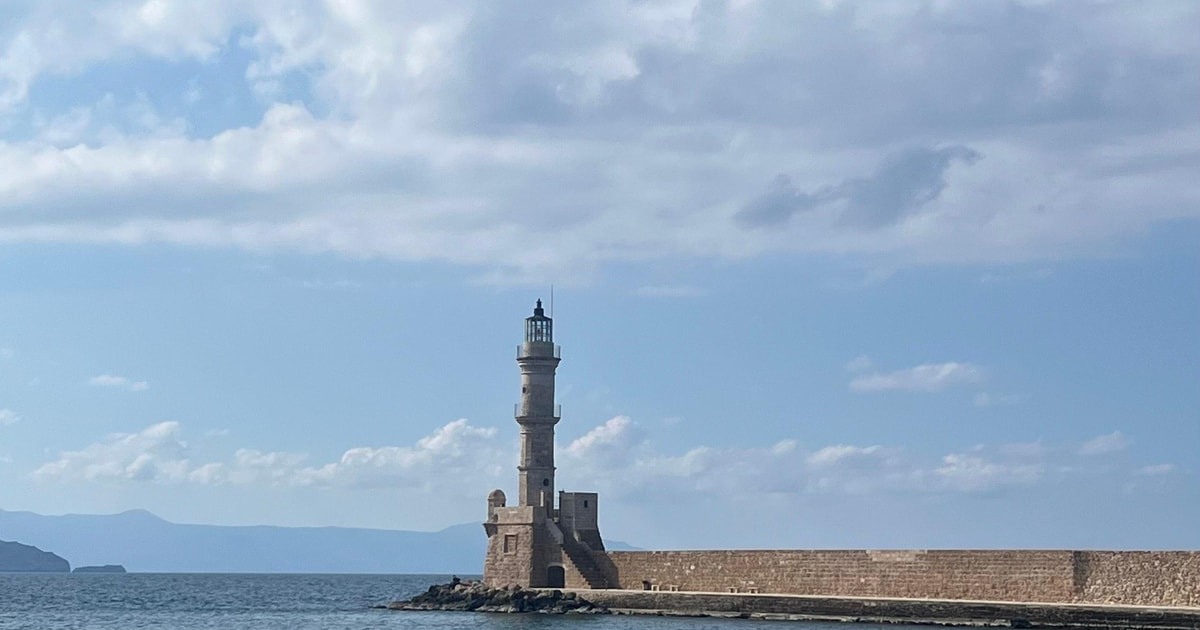
The lighthouse at the harbour entrance is a stone masonry tower. At the top it has a gallery and a light that flashes red. It stands on the site of the original Venetian lighthouse, which began as a naval post to protect the city. Egyptian troops rebuilt it, and only the base of the original remains.
The Ottomans built the Küçük Hasan Pasha Mosque, or Yali Mosque, on the harbour. It is a former mosque now, and its minarets were demolished. Later it served as a storehouse, a folklore museum, a visitor centre and an exhibition hall. A picture caption names the Venetian shipyards, but no page says where they stand.
Pack flat shoes and a camera, and look up each landmark on a map before you go. Check on the day what is open. Leave spare time in your Chania 9D cinema day, so you do not rush the harbour.
What Is In The Old Town Of Chania?
The old town of Chania is the walled quarter around the harbour. It is the core around which the whole urban area developed. Its borders are the partly destroyed old Venetian wall and its bulwarks. Parts of the Byzantine and Venetian walls remain.
Kasteli, the central part of the old town, lies on a small hill right next to the seafront. The Splantzia quarter sits next to the east part of Kasteli and is largely untouched. Eleftherios Venizelos Square, also called Syntrivani, is the main square. The Firkas Fortress lies close to the San Salvatore Bastion.
Topanas lies next to the square, on its west side. It has narrow alleys and old buildings, and restored ones now hold hotels, restaurants and shops. The indoor market, the Agora, is on the edge of the old town. Choose the alleys or the market first for your Chania 9D cinema day.
The alleys and houses were rebuilt, ruined and rebuilt again with details from different epochs. Wikivoyage says the atmosphere of the town reflects a Venetian and Turkish past. The beaches begin not far from the old town, and the nearest is Nea Hora. Check each place’s opening details before your Chania 9D cinema day. The 45-minute Chania 9D cinema ticket leaves the rest of the day free for these streets.
What Was Ancient Kydonia?
Kydonia was an ancient city at the site of present-day Chania, near the west end of Crete. It is known from archaeological remains dating back to the Minoan era and from literary and historical sources. Learn the name before your Chania 9D cinema trip, and Chania’s past will make more sense.
Excavations on Kastelli Hill have found pieces of broken pottery. Wikipedia says the Linear A and Linear B tablets found at Kydonia point to an archive. The base of the Hellenistic wall can be seen below the Byzantine wall of Kastelli Hill. Its necropolis, or burial ground, is large and includes graveyards from all periods.
The Archaeological Museum of Chania holds a large collection of Minoan and Roman artifacts excavated around Chania. The collection includes pieces from Kydonia, among other ancient cities. The museum contains coins, jewellery, vases, sculpture, clay tablets with inscriptions and mosaics. Finds from ancient Kydonia are largely stored in this museum.
That list covers what the collection holds, not what is on show. Check the museum’s own pages for its display and opening days before you plan a visit. Do the same for the Chania 9D cinema and read its official pages first.
Which Myths Does The Chania 9D Cinema Film Mention?
The official page of the Chania 9D cinema lists scenes from the legends of Crete. Among them are the birth of Zeus, the abduction of Princess Europe and King Minos. It names the Labyrinth with the Minotaur, Ariadne’s ball of thread with Theseus, and flying with Icarus and Daedalus.
According to the myth, the Minotaur had a bull’s head and tail on a man’s body. In the myth, Daedalus designed and built the Labyrinth to hold the Minotaur for King Minos. According to the myth, Daedalus built it so cunningly that even he found it hard to escape.
In the myth, King Minos asked the sea god Poseidon for a snow-white bull. According to the myth, Minos’s wife Pasiphae fell in love with the bull and bore the Minotaur. In the myth, Minos’s daughter Ariadne gave Theseus a ball of thread to find his way through the Labyrinth.
In the myth, young Athenians were sent to the Minotaur, and the hero Theseus volunteered to slay it. According to the myth, Theseus killed the Minotaur. Theseus is a figure of myth, and his existence as a real person has not been proven.
According to the myth, the craftsman Daedalus made wings from feathers and beeswax for himself and his son Icarus. In the myth, Icarus flew too close to the Sun, the beeswax melted, and he fell. Read these stories before you go to the Chania 9D cinema. The official page lists scenes about Minos, Theseus and Daedalus.
What Is Crete, And What Are The White Mountains?
Crete is a Greek island in the southern part of the Aegean Sea. Wikivoyage calls it the largest of the Greek islands. The island has four regional units, which run from west to east: Chania, Rethymno, Heraklion and Lasithi. Keep this layout in mind for any Chania 9D cinema trip.
Crete forms the southern edge of the Aegean Sea. The Sea of Crete lies to the north of it, and the Libyan Sea lies to the south. The Cyclades lie north across the Sea of Crete, and the Dodecanese lie to the northeast. A high mountain range crosses the island from west to east.
The White Mountains, also called Lefka Ori, are one of the six mountain groups in that range. They lie in western Crete, in the Chania regional unit, south of the city of Chania. They consist mainly of limestone, and the name comes from the off-white colour of the peaks. The range also has about 50 gorges.
Open a map of Crete when you plan your day around the Chania 9D cinema. Find the four regional units, then find the west, then find the White Mountains there. Those steps show you which corner of the island your day belongs to. The Chania 9D cinema and the White Mountains sit in the same regional unit.
What Is The Weather Like In Chania?
Chania has a hot-summer Mediterranean climate, with sunny, dry summers and mild winters. That climate is the setting for any Chania 9D cinema day, whatever the season. The west of the island gets more rain than the east. The local weather also varies with the terrain, the region and the elevation. Snow and frost are rare near the coast.
The pages describe the summer months as hot and dry, with clear-sky weather almost every day. A seasonal breeze from the north, the Meltemi, can ease hot, dry days. The etesian winds, called Meltemia, come in from the Aegean Sea and cool the hot days. Sunny intervals are frequent in the windy winter as well.
The 3D museum and the Chania 9D cinema are indoors. So rain or hot weather changes the day around the ticket. Put your outdoor plans on clear days, and use a wet day for the ticket. Climate describes a season, not a day, so check the forecast the evening before. The ticket page shows a free cancellation label.
Which Other Chania Tours Does This Page List?
This page also lists 43 other Chania tickets, and none of them is a Chania 9D cinema ticket. They are separate outings with their own titles, lengths and places. Read them as extra plans for the same stay in Crete, not as stand-ins for the cinema.
Five titles name Knossos or a Minoan palace. Four titles name Elafonissi, and four more name Balos or Gramvousa. Three titles name Imbros Gorge. Each group is counted from the titles alone. Because each of these places appears under more than one ticket, compare the titles one by one before you pick.
Nine titles are food, wine, olive oil or cooking tickets. Ten are boat, cruise, snorkel or submarine tickets, and seven are walks or old town tours. Two are museum tickets, and two are gorge or canyon trips. Two titles name Lake Kournas. A title can fit two groups, so the counts overlap.
The lengths are far apart. One ticket from the boat group shows 35 minutes. One walk ticket shows 2 hours, and one Knossos or Minoan palace ticket shows 9 to 11 hours. Compare the length and the places each title names, then choose the plan that fits your day in Chania.
How Do You Book The Chania 9D Cinema Ticket?
You book the Chania 9D cinema ticket on GetYourGuide in three steps. Open the ticket page, choose a date and the number of travellers, and pay on the booking page. Count your group first, so the number of travellers is right. Choose the date next, a day when everyone in your group is free. Pay last.
Next, read the length on the page, which shows 45 minutes, and then read the page text. Check the labels and the notice time of 30 minutes. Match each label to the needs of your group, and skip the ticket if a label does not fit. When the booking is done, keep the ticket on your phone.
Chania 9D Cinema: Questions And Answers
How long is the Chania 9D cinema ticket?
The length is 45 minutes on the ticket page. The official FAQ also gives 45 minutes in all for the whole experience at the venue. Plan around that and leave the rest of your day open.
Is the Chania 9D cinema ticket wheelchair accessible?
Yes, the ticket shows the wheelchair accessible label. The official FAQ answers yes for strollers and wheelchairs in both the 3D museum and the 9D cinema. Read the ticket page for the exact rules that apply.
Is there an audio guide with the Chania 9D cinema ticket?
An optional audio guide label is on the ticket page. The official pages say each guest gets headsets and a choice of 14 languages. Decide which language you need, then read the ticket page for details.
Can you cancel the Chania 9D cinema ticket for free?
Yes, the ticket page shows a free cancellation label. The label gives the short answer, so read the rest of the page for the exact terms. Then plan your travel dates with those terms in mind.