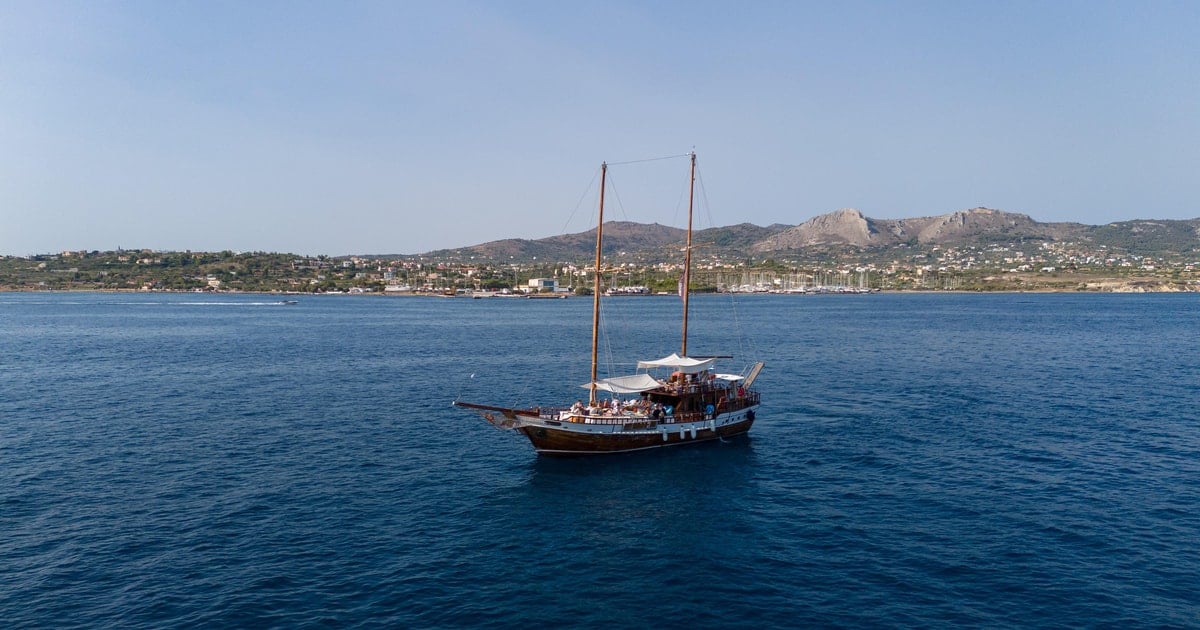
The Athens to Aegina ferry is the boat link from the port of Piraeus to the island of Aegina in the Saronic Gulf, and GetYourGuide sells tickets for it. Our Greece tours page lists day trips across the rest of the country.
This page shows the Athens to Aegina ferry tickets by length and labels. It then covers Piraeus, ferries and hydrofoils, Aegina Town, the Temple of Aphaia, the pistachio, the weather and how to book.
Table of contents
What Is The Athens To Aegina Ferry?
The Athens to Aegina ferry is the boat link between Piraeus, the port of Athens, and the island of Aegina. Piraeus is where the trip starts, and Aegina is where it ends. The ticket pages on GetYourGuide use the word ferry for the boat that makes this crossing between the two places.
This page lists 60 tickets in total. Of these, 43 carry the name Aegina in the title, so the island runs through the list. That number counts tickets of every type, not only the ferry ones. Every ticket has its own page, and the title is the first sign of what you buy.
Three of the tickets are ferry-only. Their titles use the words to/from Aegina. That makes each one a return ferry ticket, so it covers the way out and the way back. These are the Athens to Aegina ferry tickets in the strict sense: the boat ride and no tour.
The remaining tickets are day trips and cruises, and 21 of the 60 are cruises. A cruise or a day trip is a tour with a plan of its own, not a bare crossing. Pick a ferry-only ticket for the boat alone and a tour for a planned outing.
Next come the page texts of the ferry tickets, then their lengths and labels. After that come Piraeus, the ferries, Aegina and the steps to book. With those parts in hand, you can compare the Athens to Aegina ferry tickets side by side. Pick the ticket first, then plan the rest of the day around it.
Which Athens To Aegina Ferry Tickets Does GetYourGuide List?
GetYourGuide lists three Athens to Aegina ferry tickets and one more ferry ticket that runs between Aegina and Agistri. Two of the three name Piraeus in their page text, the third starts from Athens, and the fourth names Agistri. Each of the four has its own page text.
One text frames a Greek island visit at your own speed, on the ferry boat from Piraeus harbor. You board the boat after the ticket reaches you by email. The other text says to depart from Piraeus and names Gate E8. It, too, says the ticket arrives by email.
The third Athens to Aegina ferry ticket is a ferry transfer. Its page text speaks of a ride from Athens to Aegina, with multiple daily departures to choose from. The same text adds guaranteed seating. Those are the words of the page, and this post adds no promise of its own.
The fourth ticket is a separate ferry that links Aegina with Agistri. Its page text speaks of a ferry ride from Aegina to Agistri in the Saronic Gulf. It then points to forests, beaches and bays on Agistri. The ticket does not start at Piraeus, so it does not replace the crossing from Athens.
Before the day of the trip, note the port and the gate that your ticket page names. Check the same lines for the Agistri ticket too, since its starting island differs from the other three. Then you know where to head for the Athens to Aegina ferry. Keep both details beside your emailed ticket.
How Long Is The Athens To Aegina Ferry?
The three Athens to Aegina ferry tickets show 40 minutes, 1 hour 15 minutes and 1 hour 25 minutes. The 40-minute ticket is titled a ferry transfer. The other two are titled a ferry boat ticket and a ferry ticket. All three titles read to and from Aegina, so each one is a return ticket.
Treat each figure as the length shown on that ticket’s page. It is a number from the page, not a sailing time you can count on for your own crossing. The three figures differ from one another. The longest is 45 minutes longer than the shortest, and the two longer ones sit 10 minutes apart.
Three day trips come with a ferry ticket. Two of them show 8 hours and one shows 1 day. A day trip figure is the tour length, so it covers the whole outing. You cannot set it beside the 40 minutes on a ferry transfer. The Athens to Aegina ferry ride is one piece of such a day.
Of the 43 tickets with Aegina in the title, 9 show 3 hours and 6 show 10 hours. Five each show 8 hours and 9 hours. Three each show 12 hours and 1 day, and two each show 1 hour 40 minutes and 11 hours. Eight lengths show once. Check the length of your Athens to Aegina ferry.
Which Labels Do The Athens To Aegina Ferry Tickets Carry?
Two of the three Athens to Aegina ferry tickets on this page carry the free cancellation label. The same two tickets carry the wheelchair accessible label. Those two are the ferry boat ticket and the plain ferry ticket. The third ticket, the ferry transfer, carries neither of these two labels and shows different tags instead.
One of the three tickets carries the skip the line label. Each of the three also carries a notice label, which names the latest time to book before the start. The three notice labels read 2 hours, 3 hours and 10 hours. The 10 hours label and the skip the line label sit together on the ferry transfer.
Across all 60 tickets on this page, 56 carry the free cancellation label and 4 do not. The pickup available label shows on 30 tickets, which is exactly half of the 60. The free cancellation count is 26 higher than the pickup count. Both counts cover every ticket, not only the Athens to Aegina ferry tickets.
Among the same 60 tickets, 16 carry the small group label. The private option or private group label shows on 24. The skip the line label shows on 12 tickets, and the wheelchair accessible label shows on 6. Labels show on the ticket page, so check your Athens to Aegina ferry ticket for your date.
Which Aegina Day Trips Include The Ferry?
Three day trips from Athens name the ferry in their titles. They are a small-group tour, an electric bike tour and a private day trip. Each one pairs the Athens to Aegina ferry with a day on the island. Their page texts, not their titles, show what the day holds.
The small-group tour lists its day in the page text. It names a pistachio farm, Paleochora Old Town, medieval monasteries and the Temple of Aphaia. The text ends with free time for swimming or lunch by the sea. The title adds ferry tickets, so the Athens to Aegina ferry is part of that day.
The electric bike tour starts with a ferry ride from the Port of Piraeus. After that, you cover the island by electric bike, and the page text promises nature and a town. The private day trip names the Temple of Aphaia and the monastery of Saint Nectarios. It adds a swim in the Saronic Gulf, weather permitting.
The titles of two more guided day trips say nothing about the Athens to Aegina ferry. One page text speaks of a full-day trip with a tour guide and the island lifestyle. The other, for a small group, names the monastery of Saint Nectarios and the Temple of Aphaia. It adds a Greek beach and Aegina Town.
Check each page text for the words ferry ticket or ferry ride. If the Athens to Aegina ferry is not mentioned, ask the seller whether the crossing is part of the tour. Do this before you decide, because the title alone does not settle the question.
Which Cruises Stop At Aegina?
20 of the 21 cruises in the ticket list have Aegina in the title. Only one cruise leaves the island out. So Aegina is the stop that nearly every cruise in the list shares. Four examples show how those cruise titles differ from one another.
7 cruises name Hydra, Poros and Aegina in the title. The first example is a full-day cruise from Athens. Its page text invites you to discover all three islands and adds a buffet lunch on board. That is a three-island day, a different choice from the Athens to Aegina ferry.
11 cruises name Agistri and Aegina in the title. One example adds Moni, and its page text names a Greek buffet with drinks on board. Another is a swimming cruise to Aegina, Agistri and Metopi. Both titles list their islands in full, which lets you set an Agistri cruise beside the Athens to Aegina ferry.
A fourth example is a sailing yacht cruise to Agistri, Moni and Aegina. Its page text adds a Greek buffet and free time on the islands. The Hydra cruise lasts 12 hours and the Moni cruise 10 hours. The swimming cruise lasts 9 hours and the yacht cruise 9 hours 30 minutes.
A cruise is a day on a boat, not an Athens to Aegina ferry crossing. So check the stop list before you pick one. Compare the island names in each title. Then read the page text for the stops it describes. A title names islands, while the page text describes the day.
What Is Piraeus?
Piraeus is a port city within the Athens urban area, in the Attica region of Greece. It lies southwest of Athens city centre, on the east coast of the Saronic Gulf. It is a marine and commercial-industrial centre. For the Athens to Aegina ferry, this is the port you need.
The city proper of Piraeus is a rocky peninsula that was originally an island. It has three natural harbours. The central harbour was called Kantharos in ancient times. Two smaller harbours to the east are still in use. Zea is also called Pasalimani, and Munichia is widely known as Mikrolimano.
The central harbour is a hub of commercial and passenger shipping. Zea and Munichia, the two smaller harbours to the east, cater to recreational craft and to fishing craft. Greater Piraeus also includes the harbours of Drapetsona, Keratsini and Perama. The western part of the port is used for cargo services.
The port of Piraeus is the chief port in Greece. It is also the chief sea port of Athens. Piraeus has served as the port of Athens since ancient times. In ancient Greece, the city gained importance because of its three deep-water harbours. The Athens to Aegina ferry leaves from that same port.
Piraeus is bounded by Mount Aigaleo to the northwest and by the Saronic Gulf to the south and west. To the east and northeast, it is connected with the rest of the Athens urban area. The port itself lies on the Saronic Gulf, on the western side of the Aegean Sea.
Wikivoyage says Piraeus occupies a huge territory and advises you to check your gate number in advance. Ticket pages for the Athens to Aegina ferry name Piraeus harbour and a gate as the starting place. Find that gate on your own ticket before you travel, so you know where to go.
The city offers more than the Athens to Aegina ferry. The Archaeological Museum of Piraeus displays objects from classical antiquity found in the Piraeus area. The Hellenic Maritime Museum shows exhibits on the nautical tradition of Greece. Fish bistros line the coast, especially around Pasalimani and Mikrolimano Bays. Those bays share names with the two smaller harbours.
How Do You Get From Athens To Piraeus?
From central Athens you reach Piraeus by metro, by suburban train or by bus. Each way brings you to the port city where the Athens to Aegina ferry begins. The Athens Metro connects with buses, trolleys, the Athens Tram and the Athens Suburban Railway.
The Athens Metro runs three lines: Line 1 (Green), Line 2 (Red) and Line 3 (Blue). Piraeus metro station is next to the port. It is the southern end of Line 1 and an interchange with Line 3. The surface station takes Line 1 trains, and the underground station takes Line 3 trains.
Line 1 connects Piraeus with the centre of Athens and Kifissia. A rider bound for the Athens to Aegina ferry can board it in the city centre. The line is overground except for an underground section between the Monastiraki and Attiki stations. Line 3 runs through the central Monastiraki and Syntagma stations.
Piraeus station is the name of two railway stations. The southern building is the metro station. The northern building is the terminus for the Athens Suburban Railway, called Proastikos. It links to regional destinations, with intercity connections by transfer at Athens Central Railway Station. The Electric Railways Museum of Piraeus is inside the metro station.
Piraeus is also served by buses and trolleybuses. Other public buses connect Piraeus with other suburbs, the southern coastal zone and central Athens. Bus and trolleybus tickets must be bought in advance, generally from kiosks or inside metro stations. A direct Airport Express bus, route X96, links Athens International Airport with the port.
Athens is the capital of Greece and the starting city for the Athens to Aegina ferry. The city sprawls across the central plain of Attica, known as the Athens Basin. Four large mountains bound the basin, and the Saronic Gulf lies to the southwest. They are Mount Aigaleo, Mount Parnitha, Mount Pentelicus and Mount Hymettus.
Pick the way that suits your hotel and your Athens to Aegina ferry ticket. Take the metro or the train if a station stands near your hotel. Take the bus if a bus stop is closer. Buy your bus ticket before you board, and keep your ferry ticket at hand.
What Are Ferries And Hydrofoils?
A ferry is a vessel that carries passengers across a body of water, and at times vehicles and cargo. The Athens to Aegina ferry fits that definition. Ferries are part of the public transport of waterside cities and islands. A small passenger ferry with multiple stops is sometimes called a water taxi or water bus.
Roll-on/roll-off ferries, shortened to RORO, are large conventional ferries named for the ease with which vehicles board and leave. A cruiseferry blends the features of a cruise ship with a RORO ferry and is also called a RoPax. Fast RoPax ferries are conventional ferries with a large garage intake and a relatively large passenger capacity.
Route length, capacity, speed and water conditions shape every ferry, including the Athens to Aegina ferry. Double-ended ferries have interchangeable bows and sterns, so they shuttle between two terminals without turning around. Foot ferries are small craft that carry foot passengers over rivers.
A hydrofoil is a lifting surface, or foil, that operates in water. Boats built with this technology are also called hydrofoils. As a craft gains speed, the foils lift its hull out of the water. That lowers drag and allows greater speeds. The foil is commonly a winglike structure on struts below the hull.
Conventional vessels take cars and motorbikes, according to Wikivoyage, while hydrofoils are for foot passengers. A Flying Dolphin hydrofoil service runs over routes in the Aegean between the Cyclades, the Saronic Gulf islands and Athens. Check the page of your Athens to Aegina ferry ticket before you plan to bring a vehicle.
Fore means the front of a ship, and aft means the rear. A bow is the foremost part, and its job is to let the hull pass efficiently through water. The stern lies at the aft end, opposite the bow. The upper deck forms the roof of the hull, and every further level is a deck too.
The ticket for the Athens to Aegina ferry lists a length of 40 minutes. Its title says to and from, so it is a return ferry ticket. The page describes guaranteed seating and sea views and carries a Skip the line label. Read the page to learn which kind of boat runs the crossing, if it says.
What Is Aegina?
Aegina is one of the Saronic Islands of Greece, in the Saronic Gulf. The island is the destination of the Athens to Aegina ferry. Its municipality consists of the island and its offshore islets. That municipality is part of the Islands regional unit in the Attica region. Athenians have long used the island as a holiday retreat.
The island is roughly triangular in shape. An extinct volcano forms the larger part of it. The southern, volcanic part is mountainous and largely barren. The conical Mount Oros is the highest rise, and from its top you look out over the Saronic Gulf. The Panhellenian ridge stretches northward, with narrow fertile valleys on either side.
The northern and western sides are stony but fertile plains that are well cultivated. They produce grain, cotton, vines, almonds, olives and figs. The island has agriculture but little industry, and sponge fisheries are of economic importance. Athenians have also established vacation homes there.
The Saronic Gulf lies between the peninsulas of Attica and Argolis and forms part of the Aegean Sea. It is also called the Gulf of Aegina. The Athens urban area lies on its north coast. The Athens to Aegina ferry links that coast with the island.
The main inhabited islands of the Saronic group are Salamis, Aegina, Agistri and Poros. The gulf also holds the smaller islands of Patroklos and Fleves. Poros is a small island-pair in the southern part of the gulf. Old pine forest covers large areas of Poros.
Agistri is a pine-covered island in the Saronic group. Hydra is counted among the Saronic Islands. A narrow strip of water separates it from the Peloponnese, and wheeled vehicles are not permitted there. Spetses allows no private automobiles within its town limits. Moni is a wooded island near the southwest end of Aegina.
Before you book the Athens to Aegina ferry, find the island on a map of the Saronic Gulf. Then locate Salamis, Poros, Agistri, Hydra and Spetses on the same map. Each is a separate island. Check that the ticket names Aegina, and read its title in full.
What Is Aegina Town?
Aegina Town is the main town and ferry port of the island, and the regional capital. It stands on the west coast, at the northwestern end of the island. The island, its main town and its ferry port all carry the name Aegina. Keep that shared name in mind when you book an Athens to Aegina ferry ticket.
Aegina port sits at the heart of the town. It has a west pier, an east pier and an inner harbour. St Nicholas Chapel, a whitewashed building, stands on the west pier. Name the part of the harbour when you arrange a meeting, since the port has three parts.
The waterfront of Aegina Town is lined with cafes, and the area near the port has cafes too. A fish market stands in an alley by the harbour. The town also has restaurants, which gives an Athens to Aegina ferry day a choice of places to eat.
The Cathedral stands on Mitropoleos street in town, with Government House next to it. Government House is a modest two-storey building. The church of Isodia Theotokou looms over the harbour. Mark all three on a map before you go, since two of them stand side by side.
The Tower of Markellos is a pink tower on Thomaidou street. It was probably built as a watch tower. The page text of the Aegina Town walking tour names this tower. That ties the tour to a spot you can mark on a map for your Athens to Aegina ferry day.
The Orphanage of Kapodistrias is a large building on the south side of town. Locals call it The Prison. It looks like a prison, and it was one. A statue in the principal square commemorates Ioannis Kapodistrias, the first governor of independent Greece. His name links the building and the statue.
The guided walking tour of Aegina Town runs 1h 40m. Its page text describes a local tour guide who shares generations-old stories and myths of the town. The same text traces the town’s history from Neolithic times to modern Greece. Decide where this walk sits in your Athens to Aegina ferry day before you book.
What Is The Temple Of Aphaia?
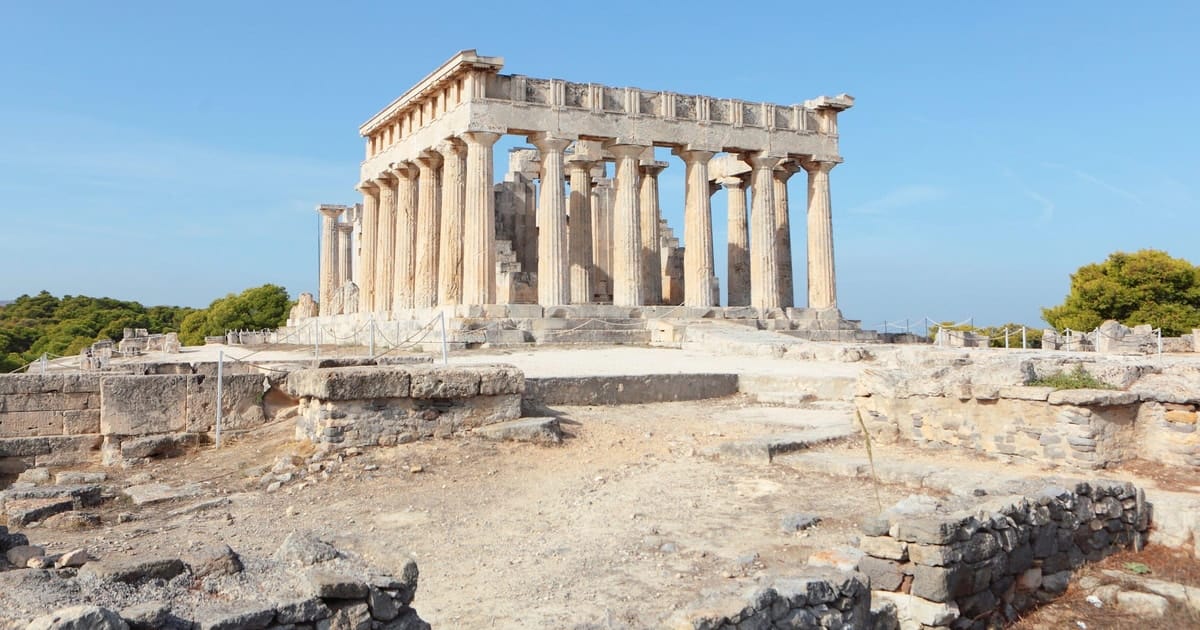
The Temple of Aphaia is an Ancient Greek temple inside a sanctuary complex dedicated to the goddess Aphaia. It stands on a hill in the east of the island of Aegina, in the Saronic Gulf. Check whether your Athens to Aegina ferry plan includes time at the temple.
The temple was formerly known as the Temple of Jupiter Panhellenius. It is now recognised as dedicated to the mother-goddess Aphaia. She was a Greek goddess worshipped exclusively at this sanctuary. Wikipedia names it as one of two notable archaeological sites of the Saronic Gulf, with the ancient theatre at Epidaurus.
The temple is Doric and stands on a ridge of pine trees. J. M. W. Turner was among the artists who depicted it. It was built over the remains of an earlier temple that fire destroyed. Parts of that older temple lie buried in the terrace infill and are well preserved.
The pedimental sculptures are on display in the Glyptothek of Munich. Fragments are in the museums at Aegina and on the site itself. Each pediment centres on the figure of Athena. The east pediment shows the war of Heracles against King Laomedon of Troy. The west pediment shows the Trojan War described by Homer, with Ajax prominent.
Kolonna lies to the north of the town of Aegina. It is an acropolis with the sanctuary of Apollo and a Byzantine settlement. Venetian sailors used the columns of the Doric temple of Apollo as a sign of orientation. Add Kolonna as its own line in your Athens to Aegina ferry plan.
The Archaeological Museum of Aegina keeps its exhibits in three rooms. They include ancient vessels, pottery, ceramics, statuettes, inscriptions, coins and weapons. The Temple of Zeus Hellanios is a Byzantine church near the village of Pachia Rachi. The church was built on the ruins of the ancient temple to Zeus Hellanios.
One 3-hour tour carries the names of the Temple of Aphaia, Saint Nectarios and Paleochora. Its page text adds myths and folklore of the island from a local tour guide. A 9-hour private day tour names the Temple of Athena Aphaia and fishing villages. Pick the length that suits your Athens to Aegina ferry plan.
What Are Paleochora And The Monastery Of Saint Nectarios?
Paleochora is an abandoned Medieval settlement on Aegina, the island’s earlier capital. The monastery of Saint Nectarios lies near it. A path leads uphill from the monastery church to the old town, so the two make a natural pair. Plan your Athens to Aegina ferry day around them if ruins and churches interest you.
Paleochora was the main centre of habitation on the island from the Middle Byzantine period onward. Its people later left it gradually and resettled in the modern town of Aegina on the west coast. That move is why the settlement is abandoned and why you meet ruins, not a living village, on the hill.
Continuous pirate raids in the Middle Ages drove the island’s people from the coast to Paleochora, a strong point inland. The north side was uninhabited, so the settlement stayed out of sight from the sea. Keep that inland setting in mind when you plan an Athens to Aegina ferry day.
The settlement was packed with small houses and churches, and two main roads led up to the castle. Hardly any house survives even as foundations, but remains of three cisterns and other structures do. Byzantine and post-Byzantine churches are preserved, and a large share still keep wall paintings inside.
The church and monastery of Saint Nectarios form a large, elaborate, modern Orthodox complex. They honour Metropolitan Nectarios, a monk who ministered in Cairo, Libya and Athens before he retired to Aegina. The Athens to Aegina ferry therefore links two places from his own life story.
Nectarios of Aegina is a recent saint of the Greek Orthodox Church. On the island he founded the Holy Trinity Monastery at the request of nuns. He lived there as a monk for the rest of his life. He tended the gardens, carried stones and helped build the monastery buildings with his own funds.
A 3-hour tour for a private group covers the monastery of Saint Nectarios and Paleochora in one outing. Its labels add pickup available and free cancellation. Confirm the pickup spot before you step off the Athens to Aegina ferry. Wear flat shoes, because the old town sits uphill from the church.
Which Villages And Beaches Does Aegina Have?
The coast of Aegina holds Perdika, Portes, Souvala, Agia Marina and Marathonas, among other places. Wikivoyage lists beaches at Souvala on the north coast, Agia Marina to the east, Marathonas and Perdika. Mesagros lies on the road that runs from the west coast towards the east. Choose two for your Athens to Aegina ferry day.
Perdika is a fishing village on the north prong of a peninsula at the southwest end of the island. A cafe strip lines the harbour, and a lane circles the headland with views towards Epidaurus. Albanians settled in Perdika, and the village also works as a resort. Walk the harbour first, then follow the lane.
Portes is a Greek fishing village on the east side of Aegina. An agricultural plain lies behind the village, with hills on its edges. Its inhabitants live mainly on fishing and tourism. A stop at Portes adds a fishing village to an Athens to Aegina ferry day. Glance at the plain behind it, not only the shore.
Souvala is the main village of the beach and resort strip along the north coast. The main accommodation strip runs along that coast, through Souvala and on to Vagia. Open a map first so you know which part of the north coast your stop sits on. Name Souvala as your area when you compare places to stay.
Agia Marina is a small harbour on the east coast of the island. Accommodation clusters around it and around Perdika. Choose Agia Marina when your Athens to Aegina ferry day leans east, and Perdika when it leans southwest. Treat each place as a base for the day, not a list to finish.
One 3-hour tour combines an olive grove, known by the Greek name Eleonas, with a visit to Perdika village. Its labels read private group, pickup available and free cancellation. Wear flat shoes for the grove, and confirm the pickup point before the day starts. Pick it for olive trees and a village in one 3-hour block.
A 2-hour tour for a private group focuses on beaches. Its page text names three: Mouriotis Beach, Afokleisti Beach, which it calls heart-shaped, and Aponisos Beach. Labels add pickup available and free cancellation. Match that 2-hour length to your own return plan on an Athens to Aegina ferry day.
What Is Aegina Pistachio?
The Aegina pistachio is the pistachio crop grown on the island of Aegina. Its local name is Fistiki Aeginis, which means Aegina Pistachios. In Greek the nut is called fistiki. Anyone who rides the Athens to Aegina ferry arrives on an island that is known for pistachio production. The trees stand in orchards.
A physician introduced the systematic cultivation of pistachios on the island, and the islanders took to it quickly. The crop was highly profitable, and phylloxera threatened the vineyards. For both reasons, pistachio growing pushed aside much of the island’s other farming. The first pistachio peeling factory opened in the Plakakia area.
The Athens to Aegina ferry reaches an island where the pistachio is tied to the land. Two things link the crop to the island: its drought conditions and the volcanic character of its soil. In general, pistachios are hulled and dried, sorted by open or closed shell, then roasted or processed into kernels.
Aegina pistachios have PDO status, short for Protected Designation of Origin, as Wikivoyage notes. The name Fistiki Aeginis is the one established as a PDO product. The shell is paler and a bit more closed than in US varieties. The kernel is red-green with an intense sweet taste.
Wayside kiosks on the island sell the nuts. Try them with salt and lemon juice to balance the sweetness. The kernels can be eaten whole, fresh or roasted and salted. In cooking, pistachios can go into desserts, chocolate, candy and ice cream, or become a paste or butter.
Before you board the Athens to Aegina ferry, get to know the tree behind the nut. A pistachio tree is small to medium-sized and belongs to the cashew family. The plants have separate male and female trees. The trees need a sunny position and well-drained soil, and the fruit needs long, hot summers to ripen.
The organic pistachio orchard tour with a factory visit runs 1 hour 40 minutes. Its description says you learn the origin of the trees, admire them up close and enjoy local pistachio snacks. The labels read small group and free cancellation. Add the 1 hour 40 minutes to your plan for the day before you choose other stops.
How Do You Get To And Around Aegina?
You reach Aegina by ferry from the port of Athens. You get around the island by bus, taxi, or a rented car, motorbike or scooter. The Athens to Aegina ferry arrives at Aegina town, the island’s main town and ferry port. It lies at the northwestern end of the island.
Island and town share the name Aegina, so the town is called Aegina town to avoid confusion. Beyond it, Souvala is the main village of the beach and resort strip on the north coast. Agia Marina is a small harbour on the east coast. Perdika is a resort village at the southwest end of the island.
On the Athens to Aegina ferry route, follow the signs for Aegina once you are inside the port. Check the electronic screens as well, because the gate can shift. Treat a gate number you hear from someone else as a guess until the screen confirms it. Keep checking the screen until you board.
The island has three bus routes, and all of them start from the bus stand by the harbour. They are not designed for sightseeing. After the Athens to Aegina ferry docks, plan the bus as a ride between places and not as a tour. If you are unsure which bus you need, ask the driver.
For a day trip on the island, hire a taxi. The driver knows the roads, the parking and how much time to allow for the return to the ferry pier. Tell the driver when you must be back at the pier, so the plan for the stops fits that time.
Five car rental agencies stand near the harbour, and they also rent motorbikes and scooters. Book ahead to ensure availability, and make that booking before you take the Athens to Aegina ferry. Choose a rented vehicle if you want your own pace. Say whether you want a car, a motorbike or a scooter when you book.
Before you buy an Athens to Aegina ferry ticket, check the port and the start place that the ticket names. Settle your way around the island before you leave, and plan the return to the ferry pier too. Keep the port, the start place and your island plan in one note on your phone.
What Is The Weather Like On Aegina?
Summers on Aegina are hot and dry. According to Wikipedia, the island has a hot semi-arid climate, type BSh in the Köppen climate classification. Greece as a whole is mainly Mediterranean, and its complex geography creates a wide range of small local climates. Facts about the whole country give a general picture, so local conditions can differ.
The meltemi is a dominant weather influence across the Aegean Basin. It is a dry north wind, also called the etesian wind. It blows from time to time through part of the summer. Its highest frequency falls in two summer months. It is sometimes called a monsoon wind, but it has no matching wind in winter.
The etesian winds peak in the afternoon and can die down at night. Sometimes they last for days without a break. Their northerly flow tempers the summer heat of the region. That is the general pattern for the Aegean, not a forecast for any one day on Aegina.
Heatwaves do happen in Greece, and along the coast the cooler sea and the sea breeze moderate the temperature. Bring sun protection for the day.
Greece has a long summer spell of near-constant sunshine. The rest of the year brings a relatively cold, rainy period across the country. Rain in the dry season arrives as rare, quick showers. These lines describe Greece as a whole, so use them as background, not as a statement about Aegina alone.
Weather can shift between the day you book and the day you sail. Open the ticket page and read the cancellation terms before you pay. Then check the forecast for your date again closer to the trip, and adjust the plan if you need to.
How Do You Book An Athens To Aegina Ferry?
You book an Athens to Aegina ferry on GetYourGuide, and the job has three parts. Start from the ticket page, pick a date and a traveller count, and pay on the booking page. Make the booking first, then plan the rest of the day around the ticket you hold.
Before you choose, compare the lengths on the ticket pages and read each page text to the end. Read the labels each page carries too. Once one ticket fits your plan, pick the date, finish the payment, and keep the ticket on your phone.
The ticket page says you receive the ticket by email. Enter an address you can open on your phone, and look in the inbox on the morning of the trip. Keep the phone charged, so the ticket is ready when you reach the port.
Athens To Aegina Ferry: Questions And Answers
How long is the Athens to Aegina ferry?
The three ferry tickets show three different lengths: 40 minutes, 1 hour 15 minutes and 1 hour 25 minutes. Each ticket page gives its own figure, so no single length fits all three of these tickets.
Which port does the Athens to Aegina ferry leave from?
Piraeus harbour is the departure point named on the ticket pages, and one of them also names Gate E8. Treat that gate as a note from that one page, not as a rule for every crossing.
Can you cancel an Athens to Aegina ferry ticket for free?
Free cancellation is a label on two of the three tickets. The third ticket does not carry the label. Open its page, read the terms in full, and then decide before you pay for the ticket.
Is the Athens to Aegina ferry wheelchair accessible?
Two of the three tickets carry the wheelchair accessible label, and the third ticket does not carry it. Check that label, and the full page text, on the ticket you plan to choose before you pay.